
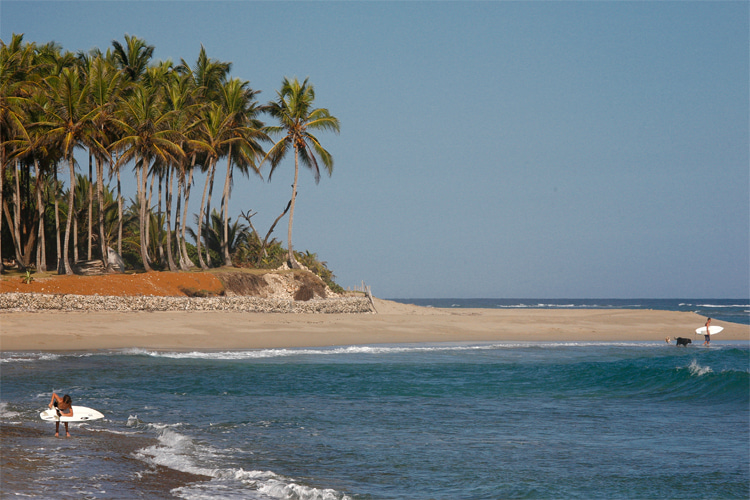

This was going to be a fun and inexpensive surf trip. I had never been anywhere in the Caribbean to surf, but stories were beginning to be told about great reef breaks off the many islands.
I had traveled all over Mexico and had surfed many places on the west coast.
I liked to brag that I had been to all four corners of Mexico: Tijuana, Matamoros, Tapachula, and Chetumal.
Technically, Chetumal was in the Caribbean, and I could remember some waves that looked rideable outside of the coral reefs, as well as the beautiful, warm, turquoise water.
My Spanish was fairly good, so a Spanish-speaking Caribbean country was preferred.
I would be traveling with my girlfriend at the time, Jan, who had never been on any foreign trips, so this was going to be somewhat of a show-off adventure for me, along with some great waves, I hoped.
It was 1970, and as with all my adventures at that time, budget travel was mandatory because, well, that’s the way I had to travel.
This meant cheap hotels, hostels, and sleeping rough, probably in hammocks in the Caribbean, with limited dining out.
And getting around would be mostly on local transport, which usually meant buses, with maybe a little hitchhiking.
I went to the local library to do a little research on a good destination that would be cheap, really cheap, had a reputation for welcoming people, and offered some interesting cultural exploring as well as the possibility of some good surf.
Safety was important, but I was not particularly worried about that.
I lived in San Diego and had a few run-ins in Tijuana with the local police, as well as a few close calls in Baja and the interior of Mexico, and always seemed to get by unscathed.
Staying calm and a few bucks would take care of most issues.
Cuba stood out at the top of places to go, but Americans could not travel to Cuba then, so that was out.

Dominican Republic and Haiti: Why Not?
Next up was the Dominican Republic, which shared the island of Hispaniola with the country of Haiti. The Dominican Republic appeared to have a great Spanish heritage, and why not visit Haiti too?
Both also seemed to be very inexpensive.
The problem was that we lived on the West Coast of the U.S., and getting to the Dominican Republic or Haiti meant flying from the East Coast somewhere.
The plan was to fly from Los Angeles to New York and from there to the capital of the Dominican Republic, Santo Domingo.
From Santo Domingo, just explore around the island looking for surf, and if funds held out, cross the border to Haiti.
Looking at some travel photos in the library of the Dominican Republic and Haiti, it looked like there were plenty of neat things to see and do with a lot of points, inlets, and reefs for waves.
Taking my 9’6″ Gordon & Smith was out of the question because of the need for multiple flights and extra luggage charges, so I was in hopes I could find a board there.
A surf buddy told me that his brother and a couple of his buddies, who were in the U.S. Marines, took boards with them to the Dominican Republic when they were stationed there in the mid-1960s.
Rather naively, I thought I could find one of those boards, or perhaps some locals had taken up surfing, and I could borrow a couple of boards.
Jan didn’t surf, but I told her I would teach her in the warm waters of the Caribbean, which she was extremely excited about.
It was August, so all we needed to pack was our bathing suits and a toothbrush.
Anything else we needed we could buy there, probably for much less than in the U.S. I also knew that during late summer Atlantic storms would often pound the Caribbean, so most likely we would get a good swell or two if we waited around some.
A friend drove us up to Los Angeles, where we caught a red-eye night flight on standby from Los Angeles to New York.
I knew there were daily flights to Santo Domingo from New York, so we hustled over to the International Terminal at JFK and managed to buy a couple of economy tickets on Pan Am Airlines.
It seemed like a short flight from New York to Santo Domingo, about four hours.
We ate, drank, and smoked all the way, with me hyping up the trip to Jan as a trip to paradise with white sandy beaches and warm, crystal-clear water.
I kept comparing the Dominican Republic to Mexico, with all its colonial architecture and friendly Indigenous people.

“Where Are We Going?”
We arrived in Santo Domingo in the late afternoon. As we departed the plane, the first thing I noticed was the airport, which seemed like it was either under repair or we weren’t at the main arrival terminal.
Immigration and customs checks were almost non-existent.
A guy in a brown military style uniform sitting at a small metal gate in the terminal didn’t even look at our passports; he just waved us on.
The flight was about half full, and it seemed like, within less than a minute, everyone who was on the flight was gone from the terminal.
Jan looked at me and asked, “Where are we going?” It was time for me to spring into action and apply my expert travel knowledge, acquired mostly from Mexico.
I said “come on” to Jan, and we stepped outside, instantly being hit with a blast of intense warm moist air. I was looking for a bus to take us to downtown Santo Domingo, where I was sure we could find a cheap hotel.
Next, several guys approached us and, in rapid-fire Spanish, tried to hustle us into taking a taxi. I kept saying “no,” but they persisted. One guy even took me by the arm and started to lead me towards his taxi.
I could tell Jan was visibly upset, and I wasn’t happy with this massive on-slot either.
We had only been in the country 20 minutes, and I could already see that this was no Mexico. For one thing, the people didn’t look like most Mexicans that I had experienced.
Right off, I noticed that Dominicans were, in general, taller with more European features but with a similar dark skin tone to most Mexicans.
Also, although I knew that the Caribbean had a history of slavery, I was a little surprised by how many Black people, and what appeared to be a mix of Black and local indigenous people, there were.
The dress was more Western too, with no culturally indigenous look to it.
We managed to shake off the taxi guys and found a way to a bus stop nearby that I was fairly sure was going into the center of Santo Domingo.
I had converted some U.S. currency to Dominican pesos in New York at the airport, but all I could get was one peso bill, which was worth one U.S. dollar.
When we hopped on a bus, which we thought was going towards downtown, I gave the driver one peso, hoping to get back some coins, but he didn’t give me anything in return.
I asked for some change as best I could in Spanish and stuck out my hand, but I didn’t get anything. I didn’t like this. I was pretty sure we had been ripped off.
Within a few minutes, we were in an area that looked urban, so we hopped off the bus.
During the bus ride, I could see that the Dominican Republic was a much poorer country than Mexico, with a lot of makeshift houses, and mostly we were on dirt roads.
Overall, I could see there was quite a bit of poverty with a lot of people standing or sitting around, unlike Mexico, where it always seemed like people were on the move.
Jan kept glancing at me with a “Where have you taken me look.”
José, Always Proud of His Bathroom’s Warm Water
The first thing we needed to do was find a place to stay for a night or two, and then explore Santo Domingo, which was right on the coast, so I would certainly be checking the surf out.
As we got off the bus, several people rapidly approached us, offering to help us find whatever we were looking for.
Again, as with the airport, there was somewhat of an on slot of people. We chose a younger guy, who introduced himself as José.
He spoke English well and told us he would help us find a place to stay and charge us just one peso to do that.
He was nice enough, but didn’t take us to a hotel. Instead, we went to his family’s house, which was a bit of a walk out of the downtown area. He said his mother rented rooms to tourists and would be happy to rent to us.
We were okay with this, and in a way, it was nice to be taken under the wing of this young guy.
José’s family lived on the outskirts of Santo Domingo in a rather dilapidated neighborhood.
The house was small with only a few rooms, two bedrooms, a kitchen eating area, and a bathroom. José was very proud of the bathroom, bragging that there was warm water.
The house had electricity with wires all over the place. I recall that José commented that soon they were going to get a telephone.
There didn’t seem to be a husband in the picture, but there were a lot of little kids around. It was hard to tell who lived there and who didn’t.
We got settled into our room quickly, which had a double bed and a small window. The house was clean and neat; however, outside was a different story. For two pesos a night, this was right on budget.
We asked José where we could get something to eat and a beer, and he said his mother would make us dinner and he would get some frias (cold beers) from a local colmado (local market).
It was a typical Dominican meal of rice and beans with some chopped mild pepper. It wasn’t as spicy as Mexican food, but it was good.
José kept running back and forth to keep us supplied with frias from the colmado. After a few frias we both started to relax, and soon we were off to bed for a good night’s sleep.
We slept well and were woken up early by the sound of roosters, a lot of roosters. We went for a shower together, mainly because I knew new shower experiences might need a couple of people to figure them out.
I instantly noticed how the hot water worked using an electrical system to heat some internal wired coils that water would flow over, then out of the shower head.
The wires around this were exposed, which I knew was dangerous, but we flipped the switch and turned the knob for hot water to flow.
Jan reached up to adjust the metal shower head and, before I could say “Don’t touch that,” she let out a loud scream.
I quickly hit the on/off switch, and she was able to let go of the shower head. If her hand had gotten stuck to the shower head while we were standing in water, we would have been rapidly returning to the U.S. as air cargo.
Soon we were dressed and ready to explore. The host had some black coffee, fresh rustic-looking bread rolls, and a little bowl of fruit jam.
I recall this jam was very sweet. I think it was guava, which I had had in Hawaii. Also, each of us got an unpeeled orange.
It was strong coffee, but it was just what we needed to get us moving after a genuinely shocking shower.
Exploring Santo Domingo
José showed up and said he had a full day’s plan for us.
He would show us around Santo Domingo and take us to the beach, and this was only going to cost us one peso.
I asked José if he knew where we could get a couple of surfboards because we wanted to surf. He thought for a few seconds, then said he had heard that there was surfing on the north side of the island near Puerto Plata, so we would need to go there to get some boards and surf.
First, we stopped at a bank, and I exchanged some pesos for centavo coins.
Next, José took us on a walk around the more urban areas of Santo Domingo. We visited a large cathedral and some old palaces and forts.
There was quite a bit of colonial architecture with some parks here and there. It reminded me of Guadalajara in Mexico.
However, most things looked like they needed repair, and the streets needed a good cleanup.
Unlike Mexico, I didn’t see too many street vendors with food or local items for sale, and there was no background sound of music.
There was an area that had small pedestrian cobblestone streets that was quaint and charming. But again, it needed some spiffing up.
As we walked around, José gave us a non-stop commentary on what we were seeing and the history of Santo Domingo and the Dominican Republic.
It’s a good thing he spoke English because otherwise we wouldn’t have known what we were seeing, and I have to say, the history lesson we got was intriguing.
We stopped for lunch at a local restaurant by the sea.
It was rice and beans again, but this time some chopped chicken was mixed in with some vegetables. We all enjoyed some frias.
We had a slow, relaxed lunch for a couple of hours.
This is when José told us of his intention to come to the United States to go to school. He was trying to save money to go to university to study to be a doctor.
Both Jan and I looked at each other with, I am sure, the same thought, “Here we are goofing around with no particular ambitions in life, but plenty of opportunity to do pretty much what we wanted.”
I think we rationalized that we were simply learning about the world and would someday get serious.
We didn’t see many people who looked like tourists, and the locals seemed to always be staring at us. We both got the uneasy feeling that we weren’t especially welcome.
We were glad José was with us because, like at the airport, it seemed like we were vulnerable to being hustled and shaken down.
I did see police standing around in several areas. They all had pistols strapped to their waist belts, with some carrying rifles. They looked like they were anticipating trouble.

In Search for Surf
José took us to a beach that afternoon just outside of town. It was a short bus ride, and as with everything that day, we paid. Nothing cost too much, so we were staying within our budget.
The beach was nice with some sand and rocks, but the break was mostly right on shore, not really surfable. But the water was clear, and it was warm.
We did take a dip, and José stripped down to his skivvies, and he went in too. But like our walk around town, we felt like we were being constantly watched.
Soon, we headed back to José’s mom’s casa for another dinner. Like the night before, we had rice and beans with frias.
That night we also had a fabulous, very sweet dessert called plátanos maduros fritos (sweet fried plantains). These were so, so delicious.
José sat with us while we ate and drank and told us about Puerto Plata, where he said there are plenty of beaches and that the waves broke out further than around Santo Domingo on reefs.
He added that more tourists would be there, not that we were looking for more tourists, but he was sure that we could find boards and places to surf.
He said the bus ride was about four hours, and buses left all day from the main station in Santo Domingo, or we could flag down a bus on the main highway going there.
I think he sensed we were not feeling comfortable in Santo Domingo.
We decided on the spot that we would go there tomorrow. We took a little stroll around the neighborhood that night, but like downtown Santo Domingo, it was a bit unkept.
It seemed to me that the Dominican Republic was a much poorer country than Mexico, but we hadn’t really seen too much of the country yet.
We slept well again, with the roosters waking us up at the crack of dawn. We skipped the shower but had the same breakfast as the day before.
We paid up our bill, which was a total of only four pesos, which included all our meals, and I left another peso next to our bed.
We felt good and were looking forward to crossing the island to Puerto Plata. José showed up around 8 am to take us to where we could get the bus.
Our host even packed us a little lunch with a couple of fresh rolls and two oranges in a small paper bag. I was in hopes some plátanos maduros fritos would be in the bag too, but no luck.
We walked a little way to a main road where the bus would go by heading to Puerto Plata. Within a few minutes, José flagged down our bus. I gave José a peso, and we both gave him a hug and thanked him.
“Be Careful and Good Luck”
As we were getting on the bus, he looked me straight in the eyes and said in Spanish, “Ten cuidado y buena suerte” (be careful and good luck).
I was used to hearing “Buena suerte” in Mexico all the time, but rarely was it preceded by “Ten cuidado.” I briefly thought, “What do we need to be careful of?”
I told the driver we wanted to go to Puerto Plata, he nodded his head, and we paid him one peso for both of us. The bus was about half full, and there was a goat passenger calmly standing in the aisle near the rear.
This bus was a little rickety, not as nice as the long-distance buses I had been on in Mexico.
The bus stopped several times along the highway to pick up passengers and a couple of times in small towns, but no more goats.
I jumped off once and got us some bottled water and chocolate candy bars to go with our rolls and oranges.
After a few hours, we arrived in the town of Santiago.
As the bus entered the downtown area, I noticed a few Spanish colonial buildings. It resembled some small towns I had been in in Mexico.
I said to Jan, “This place looks kind of interesting, let’s get off here and get something to eat and maybe stay the night.” She said, “Okay.”
Also, I said smiling, “Maybe we can find some plátanos maduros fritos to snack on. She smiled back and nodded her head.
The bus stopped near a town square that looked like a Mexican plaza.
We grabbed our stuff and hopped off the bus. As I left the bus, I glanced back at the goat in the aisle who continued to patiently wait for his or her stop.
I was looking around for a restaurant and a small hotel as we started walking towards the plaza. I could see that Santiago was much more laid back than Santo Domingo.
Come With Us
As we crossed through the center of the plaza, walking around a fountain, I noticed two young guys walking directly towards us.
As they got within about ten feet, I saw the guy who was directly facing me lift his shirt up and pull out of the center of his waist belt an old-style six-shooter revolver.
I paused, but he kept coming right at me. The next thing I knew, he forcefully pushed the barrel of the gun into my t-shirt and stomach.
I stopped instantly, but he pushed so hard I needed to take a couple of small steps back. Jan stood there, fixed on the gun that was in my belly.
The guy with the gun started speaking Spanish so fast that I couldn’t understand. It was something that sounded like, “Ven con nosotros” (come with us). I immediately said, “No problema” (no problem).
The pressure of the gun’s barrel in my belly was intense. When I looked down, I could see the guy’s finger on the trigger, and the firing hammer was cocked.
I was sure this meant the gun was ready to fire with just a light squeeze on the trigger. This guy meant business.
Jan stood there watching while the guy with the gun kept rapidly saying something in Spanish.
Next, the guy pulled the gun from my stomach and stepped behind me, then pushed the gun barrel into the center of my back.
Jan and I both had little knack sacks that hung over our shoulders, so the gun barrel was not obstructed by anything.
The other guy grabbed Jan by the arm. She wisely did not resist. They proceeded to walk us single file out of the park and down a side street.
There were people around that I knew could see what was happening, but no one seemed to visibly pay attention.
As we were walking, I started to say something to Jan and was immediately told, “Silencio,” (don’t speak).
I first thought we were being kidnapped, which seemed unusual because obviously we were a couple of poor-looking travelers, but maybe we looked like someone who had committed a crime.
But why would we be leisurely strolling through a public area if we had done something illegal?
As we were walking, I said, “Mucho dinero” (much money), figuring that might get us out of this. Again, I was told, “Silencio.”
Jan was behind me with the other guy, so I couldn’t directly see her, and she had not said one word. She was surely scared, as was I, but somehow our adrenaline kept us moving.
Within a block, we turned into a small passageway, then into an internal courtyard of a two-story building with covered walkways.
All the way, the guy kept the gun barrel pushed into my back, and I assumed the firing hammer was cocked with his finger still on the trigger.
I didn’t notice any signs anywhere, but it looked like some sort of office area with some benches in covered areas. About then, I spotted a couple of guys in what were clearly military uniforms.
We approached a door, and the guy said, “Alto” (stop).
I glanced around and saw the other guy pointing to a bench and saying something to Jan. She quickly sat down.
Next, the guy hollered out something and, with his free hand, reached around me, turned the knob, and pushed the door open.
Finally, the guy took the gun from my back and then pointed at a chair facing the desk, which I quickly sat down in.
An older, official-looking guy was sitting on the other side of the desk.
As I was sitting there, the two guys had a brief conversation in Spanish. They were speaking so fast that I could not understand what they were saying.
I glanced around and noticed the guy put his gun back into his waistband, which gave me a little relief.
However, I knew Jan and I were in trouble, “But what had we done?”
What was odd was that no one had asked Jan or me for any identification, and no one had searched us. Also, there was no attempt to handcuff us or for us to put our hands up or on our heads.
Maybe there was no need for that, given a bullet was just a couple of inches from entering my stomach or back.
As I looked around the office, it was like a warehouse of guns, with all types of weapons leaning against the walls, and some guns just lying flat on the floor.
There were even a couple of pistols just lying on the top of the desk right in front of me. One was in a holster with a belt, and the other was just sitting there.
I did not know anything about rifles or pistols, for that matter, but I did know what a shotgun looked like, and I could see several of those.
Also, if this was some sort of administrative office, there were no papers or a typewriter on the desk, and no filing cabinets. Instead, there were stacks of bullets in small boxes on the desk and floor, too.
A funny thought entered my head from when I was a young boy and went through a gun safety course.
“If my instructor saw how all these guns and ammunition are lying around like this, he would go ballistic, hollering at everyone in the class, which he did occasionally.”
Of course, it wasn’t too safe to put a loaded and ready-to-fire pistol in someone’s stomach or back either.
The guy behind the desk spoke a little English and asked me what I was doing in Santiago. I said, “We are on vacation and just got off the bus to get something to eat, and we are going to Puerto Plata.”
I did not try to speak Spanish because I knew I would say something that might be misinterpreted.
The strangest thing then happened, without anything else being said, the guy behind the desk got up and left the office.
I immediately thought, “This guy left me here alone with all these guns.” This indicated to me, I thought, that Jan and I were not a threat.
Also, I was smart enough to know that grabbing a couple of guns and trying to shoot our way out of there would be a very stupid idea.
As I sat there, I thought I could hear Jan sobbing, which upset me, but I knew it was best to sit tight and not cause any trouble and just try to keep my own composure.
We Are Not Americans Joining a Marxist-Leninist Group
In a few minutes, the more official guy came back and said in good English, “You can go.” I quickly stood up, turned towards the door, and walked out of the office.
Jan was sitting there on the bench, looking sad, but perked up a little when she saw me.
I looked at her and said, “We can go, let’s get out of here.” She got right up, and we both went through the little courtyard area and out the passageway to the street.
But our ordeal wasn’t over yet.
When we got through the passageway to the street, the same two guys who brought us there were waiting for us, and they had a car.
No guns were drawn, so that was good, but they had the door open to the back seat and pointed at us to get in.
I grabbed Jan’s hand and paused for a few seconds. I thought, “What is this all about? We were just told we could go.”
We could run, but surely, we would not get away, and maybe get shot in the process. I knew we weren’t too far from the bus station, so there was no need for a ride there.
Then one of the guys said, “A Puerto Plata” (to Puerto Plata). I said, “No gracias” (no thanks), but they insisted, saying, “Está bien,” (it’s good).
I also thought if we didn’t get in, we would be in trouble again, plus we were anxious to get going.
We reluctantly climbed into the back seat of what was an old four-door late 1950s Ford.
I made some stupid offhand comment to Jan, “My brother had a car like this that he used to drag race.” She looked at me as if to say, “What are you talking about?”
The two guys climbed into the front, started the car, and we were off.
We headed right through town, passing right by the plaza area and then by the bus station. Soon we were in a rural area with a lot of farms.
I could tell Jan was scared, as was I, so I said to Jan, “I think they are headed towards Puerto Plata.” However, it did not look like we were on a main road, and I didn’t see any road signs with directions to anywhere.
Soon, they pulled over to the side of the road and waved for us to get out.
“Oh s**t,” I thought, “These guys are going to kill us.” I said something to Jan like, “I’m sorry.”
We did get out, but they stayed in the front seat and just sped away.
Jan and I hugged and kept saying, “What had just happened?” “Did they think we were drug dealers?” “Did we look like someone who was wanted?”
We weren’t sure, but I had a suspicion that they thought we were in the Dominican Republic to join up with some revolutionary gorillas, but I didn’t say anything to Jan about that.
Later, I figured out that was probably what they thought because, apparently, some Americans had joined up with a Marxist-Leninist group that was trying to overthrow the Dominican government.
We walked for a while to what looked like a main road, flagged down a bus that took us to another road, where we flagged down another bus to Puerto Plata.

Next Stop: Haiti
After just one night in Puerto Plata, we decided the Dominican Republic was not for us, although it was beautiful around Puerto Plata with lush vegetation and gorgeous turquoise water.
I did spot some small waves off the coast that were breaking on a reef quite a ways out, but I didn’t see any surfers or surfboards for that matter.
I cautiously asked Jan, “Do you still want to go to Haiti?” Surprisingly, she said “yes.”
We caught a flight from Puerto Plata to San Juan, Puerto Rico, then from there to Port-au-Prince, Haiti.
Haiti was totally different than the Dominican Republic and Mexico. For one thing, everyone spoke French, and everyone was black.
Understanding and speaking French was no problem because Jan had taken three years of French in high school.
Also, Haiti was a lot cheaper than both the Dominican Republic and Mexico, which was good for our budget.
We didn’t stay in Port-au-Prince but instead took a bus directly to Cap-Haitien on the north coast of Haiti.
Cap-Haitien was not that far from Puerto Plata, but the Dominican Republic and Haiti were in some sort of dispute, so you couldn’t physically cross a land border.
We spent a couple of weeks in Cap-Haitien with no hassles from anyone.
Very seldom did we see anyone who looked like the police or the military.
The one exception to this was a special military police unit that was armed with pistols, rifles, and batons, called the Tonton Macoute, but they had no interest in tourists.
However, the locals were terrified of them.
It looked like there was surf in several places near Cap-Haitien, but Cap-Haitien itself was in a bay.
We took the local buses all over, exploring and looking for surf in a number of places that seemed rideable.
There were some points and beach breaks, but mostly it was reef surf, like what we saw in Puerto Plata. But we had two problems: it was mostly flat, and there were no boards that we could locate.
But Haiti was not a bust at all. Along the coast, it was mostly green and tropical, with usually a warm breeze, and mountains in the distance. It resembled Hawaii in a lot of ways.
The food was great, which was more rice and beans, but it was better than in the Dominican Republic because it was much spicier.
But it was those plantains frits au sucre brun (fried plantains with brown sugar) that totally won us over.
On our first night in Cap-Haitien, a voodoo parade with drums, chanting, and dancing came by the guest house where we were staying.
As we watched, they motioned us to join in, which we did. There was no turning back after that.
From that time on, we always participated when we saw one of these parades.
The drums, chanting, and dancing put us in a trance, in a good way. I almost forgot about our brush with mortality in Santiago.
But I don’t think Jan ever forgot because every time I asked her if she wanted to go on another surf trip with me, she had an excuse for why she couldn’t go.
Words by Jerry Olivas | Surfer and Computer Education Specialist
Leave a Reply