
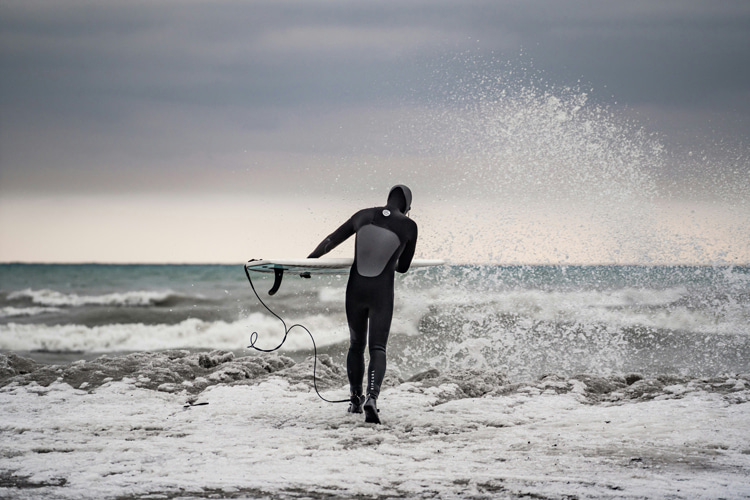

Thickness is one of the most important features in a surfing wetsuit. It determines most of the level of protection from cold water a surfer gets.
A 5/4/3 wetsuit is a cold-water winter suit designed to keep you warm during long sessions in low water temperatures while still allowing enough mobility to paddle effectively.
In the past, you would barely see them for sale in surf shops. But nowadays, comfort has become an innegotiable necessity.
You may have wondered what these cryptic numbers mean: 5/4/3.
They refer to the neoprene/Yulex thickness in millimeters: the suit is thickest in the torso (5 mm) to protect your core, slightly thinner in the legs (4 mm), and thinnest in the arms and shoulders (3 mm) so paddling doesn’t feel overly restrictive.
It makes sense.
The thickness distribution is particularly targeted at surfing, where you spend a lot of time stationary in the lineup waiting for the waves.
So, because you’re not constantly on the move, your core gets an extra millimeter of artificial skin. And when you want to paddle for the right wave, you get the freedom of the three millimeters.
When to Put On a 5/4/3
The 5/4/3 mm wetsuit is not for everyone.
Actually, there are experienced surfers who probably never had to wear a wetsuit, for instance, in Hawaii.
Usually, surfers buy and use a 5/4/3 wetsuit in water temperatures between about 45-54 °F (7-12 °C), particularly when cold air and wind are also part of the equation.
In these conditions, a thinner suit – it could even be a 4/3 – can quickly lead to shortened sessions due to near-hypothermia and loss of confidence in harsher ocean conditions.
On the other hand, a 5/4/3 allows you to stay out for hours without losing core warmth. And that changes everything.
When temperatures drop even further, many surfers move up to a hooded 5/4 or 6/5/4, but for most cold-water locations, a 5/4/3 sits right at the sweet spot.
And you ask, yes, there are 6/5/4 mm wetsuit models available in the market.

Where to Wear a 5/4/3
Geographically, this type of wetsuit is most common in mid- to high-latitude surf regions during winter.
In Europe, surfers rely on 5/4/3 suits throughout the winter months in places like the UK, Ireland, northern France (especially Brittany), northern Spain, Portugal, and around the North Sea.
In North America, it’s an increasingly standard winter choice for Northern (Santa Cruz and San Francisco) and Central California (Big Sur), the Pacific Northwest (Tofino), and the northeastern United States from late fall through early spring.
Cold ocean currents make it equally relevant in parts of South America, particularly central and southern Chile and Patagonia, where water temperatures remain low even when the air warms up.
A 5/4/3 is also used in the colder parts of the Southern Hemisphere during winter, such as Tasmania (Shipstern Bluff), Southern Australia (Bells Beach), and much of New Zealand, where wind chill can be just as challenging as water temperature.
In parts of Asia, especially along Japan’s Pacific coast, surfers depend on 5/4/3 wetsuits to make it possible to be in the water through the winter months.
As crazy as it might sound, in extreme North Atlantic locations like Iceland, Finland, Norway, or the Faroe Islands, a 5/4/3 can be your standard summer suit that could need to be paired with additional thermal protection.
This wetsuit is almost always worn with booties, gloves, and a hood, either integrated or separate, since heat loss through the extremities (head, hands, and feet) is significant in cold water.
But then, at the same time, it’s not a suit you’d want in milder conditions.
Once water temperatures rise above roughly 55 °F (13 °C), most surfers switch to a 4/3 or thinner, as a 5/4/3 becomes unnecessarily bulky and can cause overheating.
Words by Luís MP | Founder of SurferToday.com
Leave a Reply