
As I write these words, Portugal experiences the worst weather-related catastrophe ever recorded.
A series of massive, back-to-back North Atlantic-fueled low-pressure systems brought unprecedented winds that reached an all-time record high of 129,7 miles per hour (208,8 kilometers per hour) in Soure, in the Coimbra district, in central Portugal.
These winds blew for several hours and, by themselves, took down the roofs of houses and industrial facilities, as well as stone and brick walls of all sorts of urban and rural structures.
Crops were decimated in seconds. A Ferris wheel in Figueira da Foz was overturned. Cars on the streets were flipped, and beach sand was carried by these nuclear winds well into the streets of coastal towns.
Tens of thousands of trees were destroyed in seconds, like toothpicks.
Leiria was only the epicenter of a larger tragedy that, in some regions, resembles post-apocalyptic Hollywood scenes from a “The Last of Us”-like episode.
But that wasn’t all.
Heavy rain added a layer of extra chaos and destruction, with floods transforming roads into rivers and causing millions of euros in damage to houses and businesses.
A war zone
Portugal never lived anything like this in modern times.
Over 850,000 people lost power when Storm Kristin hit the southwestern European nation in the last week of January.
Several cities became war zones, cut off from the outside world without communications, electricity, water, and gas supply. High-voltage transmission towers were obliterated.
Several people died. The state of calamity was declared.
A week later, heavy rain and wind gusts continue to slam the Portuguese territory. Dams have reached their maximum capacity and will need to release water. Floods in major cities like Porto and Coimbra are inevitable.
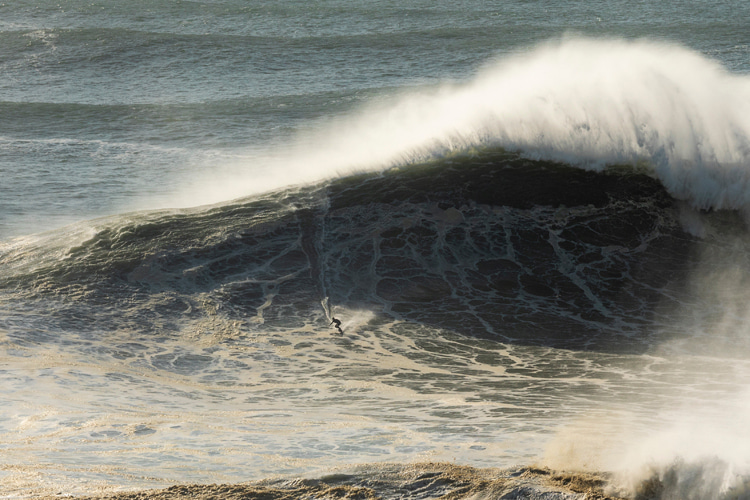
Swells were the mirror of the atmosphere.
I’ve witnessed Windguru with buoys expected to record wave heights of 16 feet (8 meters). That’s something totally new for me.
There’s confirmed evidence of the partial destruction of a massive breakwater wall that has been standing firm, sturdy, and unbeatable for around a century, and exposed to North Atlantic winter swells.
A hole has been dug in the stone structure by pounding waves. Can you imagine what it takes to create that?
A January as I’ve never witnessed
January is usually the coldest and rainiest month in Portugal. It’s also a time when Nazaré roars and shines to life.
However, for the average surfer, the first month of the year is a window of very few opportunities, as giant walls of whitewater are what you mostly see in the water from the beach.
In a land of beach breaks, sensitive to bathymetric changes, you could experience paradise or hell. But it’s mostly the latter.
But January 2026 has been unlike any other.
Cold, rain, super dark clouds and skies, and gusty winds were constant throughout all 31 days of the month, and I had no chance but to stay dry.
I don’t recall landing in February and realizing that the last time I surfed was last year. It’s unimaginable.
The call, the need, the urge to surf
Those who surf know the feeling. It’s like an innate, instinctive, primal drive.
When you’re out of the ocean for a relatively long time, you slowly build a hangover mode caused by the lack of touch with the waves.
The last time I developed it was during the 2020/2022 pandemic. But this time, it is the weather keeping me on terra firma.
The impact of the absence of surfing in my life is first noticeable to me, and then to others around me. I feel it in my body and mind. It’s like an inner anxiety building in my chest.
And then also “saudade,” a Portuguese word that defines a feeling that cannot be exactly translated into any other language. It’s a mix of longing, nostalgia, melancholy, aching, and a few other human emotions.
Surfing calls us when we need it. It triggers an urge that, when fulfilled, makes us the happiest human beings on planet Earth.
And then, when I get back after a more or less prolonged period of abstinence, I always, always tell myself: “Why don’t I do this more often?”
I do believe everything happens for a reason. I mean, generally, even though not all events in our daily lives appear to come at us with a meaning or purpose.
Which raises questions.
Do we sometimes need to take a break from riding waves or doing something we love dearly? Should we force ourselves into the water? How much surf do we need to live a balanced life? Are we full-on or in an in-between state? What type of connection should I maintain with my surfing out of the water?
By now, my wetsuit should feel like a dried and salted cod.
Words by Luís MP | Founder of SurferToday.com
Leave a Reply