

The ocean and its waves have always been depicted on a blank canvas. Artists, and painters in particular, have been pouring the rawness and violence of swells into two-dimensional artworks. Learn more about the most famous painting of waves ever created.
For centuries, swells were nightmares that defied any sailor’s soul.
Whether witnessed from the shore or experienced in a caravel amidst high seas, waves have always fascinated painters from all over the world.
We at SurferToday.com selected 14 works of art that are historically and culturally relevant and tell a story of how the mountains of the oceans were drawn, colored and/or illustrated by painters through time.
Stormy Sea | Abraham Willaerts | 1629

Abraham Willaerts worked in the Dutch Republic at a time when the sea was the country’s highway, battlefield, and source of wealth. His “Stormy Sea” shows a restless ocean under a heavy sky, with ships tossed by waves that seem to rise without warning. The painting reflects the Dutch Golden Age taste for marine scenes, which celebrated both the nation’s seafaring power and the danger that always came with it.
Willaerts often painted naval encounters and rough weather, and this work fits that pattern. The ships look small against the rolling water, which gives the scene a sense of risk rather than heroism. Instead of focusing on one dramatic moment, he spreads the action across the canvas, letting the viewer wander from one struggling vessel to another.
The waves are dark and thick, painted with careful strokes that show the artist’s close study of real seas. For viewers in the 1600s, the painting would have felt familiar, almost like a news report from the coast.
Dutch Warships in Trouble off Gibraltar | Ludolf Bakhuizen | 1690

Ludolf Bakhuizen was one of the most famous marine painters in the Netherlands. He had worked as a clerk before turning to art, and he studied ships with the focus of a sailor. In this painting, Dutch warships fight both enemy waters and a wild storm near the rocky coast of Gibraltar. The sky churns with clouds, and the waves lift the ships like toys.
Bakhuizen was known for showing storms in a dramatic but believable way. He studied real ships and even went out in rough seas to observe how water behaved around the hull. The result is a painting that feels tense and physical. You can almost hear the wind pushing through the rigging.
The ships lean at steep angles, and the cliffs in the distance suggest that danger is coming fast. It is not a calm naval portrait. It is a moment when nature takes control, and even powerful warships look fragile.
Shipping Scene from the Collection of John Chicheley | Elisha Kirkall | 1720s

Elisha Kirkall was known for prints and paintings that copied or adapted marine scenes by other artists. This work in particular, linked to the collection of John Chicheley, shows a busy stretch of water filled with ships riding uneven waves. The sea is active but not fully out of control. It looks like the kind of day when sailors keep a close eye on the horizon.
Kirkall worked during a period when prints of sea battles and shipping scenes were popular with collectors. They decorated homes and reminded viewers of Britain’s growing naval power. The waves here are carefully shaped, with white foam curling around the hulls. The ships are detailed, almost like portraits.
Even though the scene is not tied to a specific event, it captures the everyday tension of life at sea in the early eighteenth century, where trade, travel, and danger were always mixed together.
Surfboard Paddler | John Webber | Hawaii | 1778

John Webber traveled with Captain James Cook on his final voyage. In Hawaii, he sketched local life, including one of the earliest European images of surfing. “Surfboard Paddler” shows a Hawaiian rider lying on a long wooden board, moving through the waves with calm confidence.
To European viewers at the time, this was a strange and exciting sight. Surfing was not a sport they knew. Webber’s drawing, later turned into engravings, helped introduce the practice to the Western world. The wave is not violent. It is smooth and clean, more like a rolling swell than a storm.
The focus is on the person and the board, not on danger. It feels like a quiet moment on the water. For surfers today, the image is important because it shows how deep the sport’s roots go in Hawaiian culture.
The Victory Returning from Trafalgar, in Three Positions | J. M. W. Turner | 1803-1806

Turner loved the sea, and he often used it to tell stories about Britain’s navy. This painting shows HMS Victory at three different moments on the same canvas. The ship sails through rough water, with waves that lift and twist around the hull. Turner was less interested in strict accuracy than in mood. The sea looks alive, with brushstrokes that blur the edges of ships and sky.
The painting was made around the time of the Napoleonic Wars, when naval power shaped European politics. For viewers of the period, the ship was a symbol of national pride. Turner, though, keeps the focus on the restless ocean. The waves do not care about politics. They move in their own rhythm, reminding the viewer that the sea is older and stronger than any empire.
The Great Wave off Kanagawa | Katsushika Hokusai | 1830-1831

Hokusai’s “Great Wave” is one of the most famous images ever made. It is a woodblock print from his series “Thirty-Six Views of Mount Fuji.” The scene shows a towering wave about to crash down on three small boats. Mount Fuji sits in the background, calm and distant. The wave looks almost like a claw, with foam shaped like white fingers.
The print was made during Japan’s Edo period, when travel and landscape art were popular themes. It was not meant as a rare artwork. It was printed in large numbers and sold at a low price. Over time, it spread around the world and influenced Western artists. The image captures the sudden power of the ocean and the small size of human life beside it.
Snow Storm: Steam-Boat off a Harbour’s Mouth | William Turner | 1842

Turner painted this storm with a wild energy that shocked many viewers. The canvas shows a steam-boat caught in a blizzard, spinning in heavy waves near a harbor entrance. The shapes of sea, sky, and ship blur together into a swirl of gray and white. Turner claimed he once had himself tied to a ship’s mast during a storm so he could study the scene.
Some critics doubted the story, but it added to the legend around the painting. At the time, steam-boats were new technology, and Turner shows one fighting against nature’s force. The painting is less about clear details and more about the feeling of being inside the storm. The viewer is pulled into the center of the spinning water and snow.
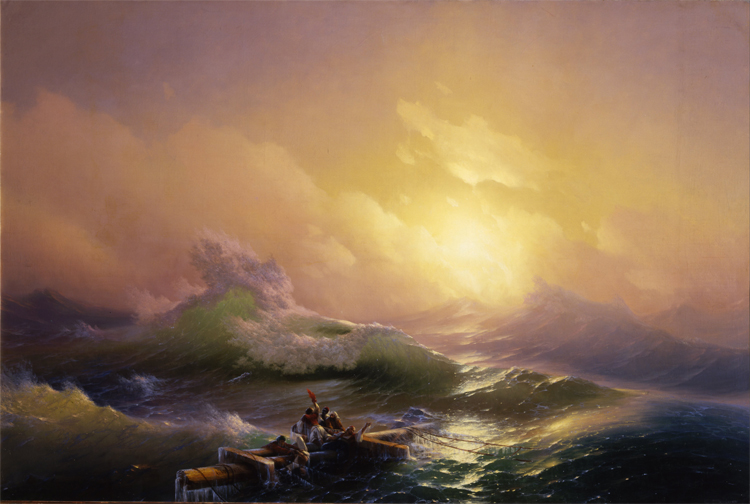
The Ninth Wave | Ivan Aivazovsky | 1850
Aivazovsky was known across Europe as a master of seascapes, and “The Ninth Wave” became his most famous work. The painting shows survivors of a shipwreck clinging to broken pieces of the mast as a massive wave rises behind them. The sky glows with warm light from the rising sun, which cuts through the storm clouds.
In maritime folklore, the ninth wave was believed to be the largest and most dangerous in a series. The painting balances fear and hope. The wave looks huge, but the warm sunlight suggests that the storm may be ending. Aivazovsky painted thousands of seascapes and spent much of his life near the Black Sea, studying water and storms.
The Wave | Gustave Courbet | 1869

Courbet painted several versions of “The Wave” during his stays on the coast of Normandy. This one shows a single, dark green swell rising toward the viewer. There are no ships or people. Just water, foam, and sky. Courbet was a leader of the Realist movement, which focused on ordinary subjects instead of myths or heroic stories.
Here, the wave is treated like a portrait. He paints it with thick brushstrokes and heavy color, making the water feel solid and weighty. The painting is simple, but it has a strong presence. It feels like a wave you could almost hear. By removing all distractions, Courbet lets the ocean speak for itself.
Barque ‘E.H. Duval’ in a Storm | Fred Wettering | 1874

Fred Wettering specialized in marine paintings that showed ships battling rough seas. In this scene, the barque E.H. Duval fights through steep waves under a dark sky. The sails strain against the wind, and the ship leans sharply as water crashes over the bow. Paintings like this were popular with ship owners and maritime collectors. They were both art and records of real vessels.
Wettering pays close attention to the rigging and the shape of the hull, which suggests he studied real ships carefully. The sea is painted with deep greens and grays, giving the storm a heavy mood. It feels like a moment when the crew must rely on skill and luck to stay afloat.
The Wave | Pierre-Auguste Renoir | 1879

Renoir is better known for sunny scenes of people, but he also painted the sea. In this small canvas, a wave curls gently near the shore. The colors are bright, with blues and greens that shimmer in the light. Renoir uses loose brushstrokes, letting the paint flicker like reflections on water.
Unlike Courbet’s heavy swell, this wave feels soft and friendly. It looks like a summer day at the beach rather than a storm. Renoir painted it during his travels along the French coast, where he studied how light changed the color of the water. The painting has a relaxed mood, as if the sea is part of a holiday.
Stormy Sea in Étretat | Claude Monet | 1883

Monet visited the cliffs of Étretat in Normandy several times. He was fascinated by the way waves crashed against the rock arches. In this painting, the sea is rough, and the sky is thick with clouds. The water is painted with quick, broken strokes, which capture the movement of the surf. Monet worked outdoors whenever possible, even in bad weather, so he could paint the real light and color of the scene.
At Étretat, he faced strong winds and cold spray, but the conditions gave him dramatic views. The painting feels immediate, like a snapshot of a stormy afternoon. The waves are not neat or polished. They are restless and unpredictable, just as Monet saw them.
Neptune’s Horses | Walter Crane | 1892

Walter Crane was part of the Arts and Crafts movement, and he often mixed myth with decoration. “Neptune’s Horses” shows waves as white horses racing across the sea. Their bodies form the shapes of the surf, with manes that blend into foam. The idea comes from old myths that compared waves to the horses of the sea god Neptune.
Crane’s style is flat and patterned, closer to illustration than to realistic painting. The colors are clear, and the shapes are simple, almost like a mural or a tapestry. The sea here is not frightening. It feels playful and magical, as if the waves are alive and enjoying their run across the water.
“Neptune’s Horses” inspired what is considered to be the greatest surf-related commercial of all time: Guinness’s 1999 “Surfer.”
An Attack on a Galleon | Howard Pyle | 1905

Howard Pyle was an American illustrator known for pirate stories. In this painting, a galleon fights for survival in a violent sea while attackers close in. The waves are dark and steep, pushing the ship toward danger. Pyle worked during the golden age of magazine illustration, and his pictures were meant to grab attention quickly. He used strong shapes and dramatic lighting to create excitement.
The sea in this scene adds to the tension. It tilts the ship and fills the air with spray, making the battle feel even more desperate. The painting reads almost like a movie still. You can imagine the sound of cannon fire and the crash of waves at the same time.
Words by Luís MP | Founder of SurferToday.com
Leave a Reply