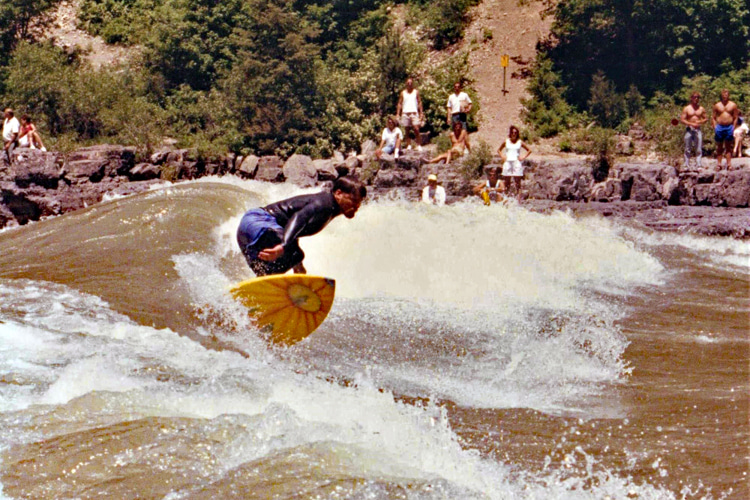

River surfing is called he’e pu’e wai in Hawaiian. He’e meaning to slide; pu’e referring to turbulence; and wai indicating fresh water. But what’s in a name?
Dodging obvious Shakespearean inferences, we can conclude that, be it river surfing, rapid surfing, or he’e pu’e wai, all convey a measure of what, where, and how the sport is performed.
Duke Kahanamoku gifted ocean surfing (he’e nalu) to the world scarcely over a century ago.
Since Westerners arrived in Hawai’i in 1778, he’e nalu has evolved from Hawai’i’s national sport and birthright to a censured water activity, a Western counterculture symbol, and now an internationally governed Olympic and professional sport.
There are important reasons for preserving the he’e pu’e wai origin stories globally, before the opportunity is drowned out.
References in ancestral chants, oral histories and moral teachings (mo’olelo), with citations in Hawaiian- and English-language newspapers and period writings by Native Hawaiians, early missionaries, explorers, and travelers to Hawai’i in the ninetieth and early twentieth centuries establish this fact: That as with all things surfing, it was Native Hawaiians who first elevated the act of surfing on stationary river waves to the level of a sporting practice.

Relevant passages arise in “The Epic Tale of Hi’iakaikapoliopele,” translated by M. Puakea Nogelmeier in 2006.
It is about a journey taken by Hi’iakaikapoliopele, the youngest and most favored sister of Pele, goddess of fire, lightning, wind, volcanoes, and new land.
This version was penned in 1905 and 1906, as a daily series in a Hawaiian-language newspaper.
In this ancient tale, Hi’iaka fondly remembers men and women surfing the river mouth in Hilo on Hawai’i Island.
Her chants from the Island of Maui reference “The women who surf the river channels.”
Not surprising to anyone who follows Jamie O’Brien’s YouTube videos, a noteworthy passage occurs by the Waimea River on the island of O’ahu.

A shape-shifting spirit, or mo’o, named Pili’a’ama was overseer for the land division (ahupua’a) of Waimea Valley.
As Hi’iaka and her traveling companion draw near, she foresees and formally chants for Pili’a’ama three different times.
It doesn’t end well for him, but in “Chant Zeventy-Four” (page 160), she specifically refers to Pili’a’ama as “surfer of the river mouth of Waimea.”

John Clark’s meticulously documented 2011 book, “Hawaiian Surfing: Traditions from the Past,” includes a section dedicated to the origins of river surfing.
It is based largely on passages Clark gleaned from nineteenth- and twentieth-century Hawaiian-language newspapers and English-language period literature.
Per Clark, he’e pu’e wai was practiced on not less than four of the Hawaiian Islands.
In addition to multiple rivers on O’ahu, Hawaiians were known to surf the Wailua River on Kaua’i, Wailuku and Waiohonu rivers on Maui, and the Wailuku, Honoli’i, Papa’ikou, and Waipi’o rivers on the Island of Hawai’i.
They surfed stationary waves where flooded rivers meet the sea, in perennial rivers, or generated by draining estuary beach ponds (muliwai).

Clark cites an 1822 journal entry by early missionary William Ellis, who describes Hawaiians surfing the “agitated water” at the mouth of a large river.
He references John Cummins’ 1913 descriptions of heʻe puʻe wai during an 1877 cavalcade with Queen Emma, wife of Hawaiian Sovereign King Kamehameha IV.
Cummins was determined “to give Her Majesty and her party a view of this ancient sport.”
He had workmen open a muliwai on the Puha River in Waimanalo, and two women and two men demonstrated their river surfing prowess for the Queen and her party.
Extensive construction of irrigation channels and flood control projects in the nineteenth and twentieth centuries occurred in parallel with an overall decline of the surfing sports as a national pastime.
Hiram Bingham, an American missionary to Hawai’i in the mid-1800s, wrote, “The decline and discontinuance of the use of the surfboard, as civilization advances, may be accounted for by the increase in modesty, industry, or religion.”

The renaissance of he’e pu’e wai in the Hawaiian Islands
Legendary Hawaiian big wave surfer, assiduous lifesaver, and heroic Polynesian voyager Eddie Aikau was an avid river surfer on O’ahu’s Waimea River.
Eddie was the first City and County of Honolulu Ocean Safety and Lifeguard Officer (aka lifeguard) for O’ahu’s North Shore.
From 1967 until 1971, he patrolled the beaches between Sunset Beach and Hale’iwa. His base of operations was at Waimea Bay, and not a single life was lost during his tenure there.
In 1978, he valiantly lost his life paddling a surfboard for help after the Hawaiian voyaging canoe Hōkūle’a, on which he crewed, floundered in high seas.

Like his elder brother, Clyde Aikau was a career lifeguard, as well as an ardent surfer on the Waimea River.
I exchanged emails with Uncle Clyde before he passed away, and when asked whether he, Eddie, and other late 1960s and early 1970s Waimea River surfers were body surfing (pae po’o), riding wooden paipo boards (foam bodyboards hadn’t been invented yet), or using conventional surfboards, he noted, “We were riding the river with anything we could get our hands on.”
When asked if they included standing (kū) in their he’e pu’e wai repertoire, he replied, “Right off the bat!”

Mark Dombroski began lifeguarding at Waimea Bay in 1974, after he was strongly encouraged to try out by Eddie Aikau. In Clark, Dombroski references how he and Eddie body surfed the Waimea River together.
He suggests that riding the Waimea River didn’t really become a thing to do until around 1972 or 73, although Hawaiian cultural practitioner Tom Pōhaku Stone notes that he and his friends were riding various O’ahu river mouths as early as the mid-1950s.
Clark assembled accounts from respected watermen of the last quarter of the twentieth century in Hawai’i.
All these stories (mo’olelo) demonstrate that the ancestral knowledge, methods, and the spiritual energy (mana) of the past were passed down from he’e pu’e wai enthusiasts of bygone eras to those of the current generation.
In “Hawaiian Surfing,” bodyboarding pioneer Hauoli Reeves was living with fellow bodyboarder Ben Severson on the North Shore.
Hauoli notes that he first heard about surfing the Waimea River in the mid-1980s from Clark Little.
Clark was surfing there with his older brother, Brock Little, and professional surfer Ronnie Burns. Mike Stewart was in on it, too.
Dombroski credits the bodyboarders for kicking off the he’e pu’e wai renaissance in the mid-1980s.

The origins of river surfing in Europe
Prior to Hawaiian origin revelations in Clark, the dominant global narrative had been that the birthplace of river surfing was in Germany.
“Brettlrutschn” (board-sliding) was a precursor to river surfing using a wooden board tied with ropes to a large tree or bridge.
Adventurers would hold onto a second rope tied to the board and lean against the river current.
Arthur Pauli, a teenager from the town of Trotsberg, made a wooden surfboard in 1965. He tied a rope to a tree branch and rode it back and forth against the current on the River Atz.
The Pauli brothers, Arthur and Alexander, first surfed unsupported at Flosslände, a river wave on the Isar River in Munich, Germany, on September 5, 1972.
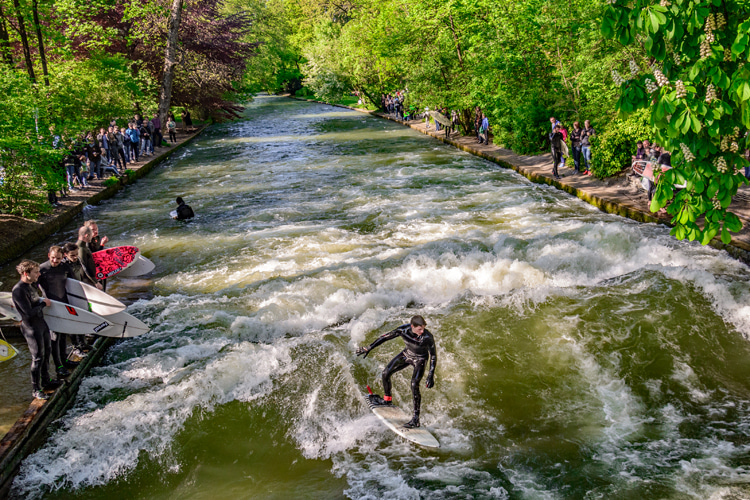
Brettlrutschn became popular at Eisbach on the Isar River in Munich, Germany. Someone realized that even when the rope sagged, their boards continued gliding on the wave.
Early devotees included Dieter “The Eater” Deventer, Wolfrik Fischer, Walter Strasser, Quirin Rohleder, Daniel Osswald, and Tao Schirrmacher, to name a few.
Since “swimming” at Eisbach was illegal, an outlaw surfing subculture developed. This mostly involved dodging the authorities, but also keeping a tight rein on pictures, videos, and who was allowed to surf there.
In 2010, advocates convinced city officials to legalize surfing, although locals continue to self-police the break.

Origins of river surfing in North America
North American river surfing history traces very precisely through Mike “Fitz” FitzPatrick, Steve Osman, and Steve Hahn, who first surfed the Lunch Counter wave on Wyoming’s Snake River in 1978.
Fitz was first to get to his feet. They had no knowledge of river surfing having arisen anywhere else.
The first organized North American river surfing competition was held on Utah’s Jordan River in 1983.
The Jordan River Hole Riding Contest was organized by kayakers, who opted to include a surfboard division. Ron Orton took first place.

In 1985, Body Glove International sent team surfers Allen Sarlo, Brian McNulty, and Jim Hogan to ride Lunch Counter. John Krisik, John Scott, and Mike Fitzpatrick coordinated logistics and acted as river guides.
The 1986 Body Glove team included Ted Robinson, Scott Daley, and bodyboarders Danny Kim and Ben Severson from O’ahu. Severson and Kim readily applied the skills they had refined on the Waimea River to the Snake River’s numbing temperatures.

Seal Morgan and I surfed the Lunch Counter from 1988 to 1991. We had it all but to ourselves.
The number of surfers gradually increased over the years from the exposure we were getting in the media, showing what was possibly the first North American community of river surfers.

Tony Jovanovic pioneered Idaho’s Lochsa Pipeline wave in 1993. In the era before tow-ins, he backed into Skookumchuck on the Sechelt Inlet of British Columbia, Canada.
The August 2000 issue of Coast Magazine notes, “In July of 1999, the newest wave-riding performance made his debut. Tony Jovanovic of Rossland, B.C., managed to claim the honor of board surfing Skookumchuck for the first time.”

The future of he’e pu’e wai in Hawai’i
The Waimea Valley is the last intact ahupua’a on O’ahu capable of producing surfable waves.
When it is on, the bodyboarders, surfers, commercial photographers, videographers, and phone-wielding tourists line the channel margins.
The drama, energy, talent, and local culture associated with he’e pu’e wai on the Waimea River is robust and will remain so into the foreseeable future.
Ocean Safety personnel manage the many hazards inherent to he’e pu’e wai on the Waimea River.

These include burial by sluffing sands, hydraulic traps, pathogenic water-borne micro-organisms, and impact injuries posed by loose surfboards, logs, and flotsam.
Hauoli Reeves suffered a career-altering injury and a near-drowning from a catastrophic sand collapse on the river.
Dombroski in Clark tells how lifeguard Kerry Atwood rescued a rider trapped in a hydraulic just under the river wave.
The river will dispassionately spit whoever loses their feet into the ocean shore-break, and Waimea Bay gets big.
Objects, including car parts, bicycles, and construction debris, are regularly washed or thrown into the Waimea muliwai, and it all flows toward the ocean.

Ocean Safety regularly scours the muliwai and marks debris for removal, yet a Waimea River rider was severely impaled by rusted rebar protruding from the sand in 2012.
They regularly post signs discouraging swimming due to the health risks associated with Leptospirosis, yet a number of Waimea River surfers have been infected with this debilitating disease over the years.
The scores of pump-driven stationary wave pools erected around the world offer a safer alternative for the average he’e pu’e wai enthusiast.
Adherence to municipal water, health, and safety regulations eliminates most of the aforementioned hazards.
They are easy to enter and exit, adjust to the different skill levels, have built-in safety features, and open new opportunities for competition.

Citywave opened the world’s largest stationary wave pool at Wai Kai in Ewa Beach on Oahʻu in February of 2023, but are they champions for preserving and advancing the ancestral Hawaiian sport of heʻe puʻe wai, or could they pose a threat to island water resources and Hawaiian cultural practices as some have implied?
Native Hawaiian representatives, Wai Kai liaisons, lawmakers, and community members are sorting it out. Fortunately, there is nothing like a little divergence for finding ways to make it right (pono).
Wai Kai incorporates he’e pu’e wai origin stories into names, narratives, promotions, and entertainment that acknowledge Hawaiian claims to their ancestral sport and birthright.
The Wai Kai Show offers the only performances in Hawai’i that incorporate live he’e pu’e wai action at remarkably close quarters.
They employ dancers, musicians, and surfers who reflect Polynesian history and the diversity of the West Side of O’ahu. There are Kama’aina (resident) rates and periodic specials that make surfing at “The Lineup” more affordable.
Wai Kai Surf League competitions are an immersive spectator experience, where the action is up close and engaging.
All competitors surf identical waves, placing a premium on skill, rather than on wave selection or luck of the draw.
For the first time, perhaps in centuries, Hawaiians are competing at he’e pu’e wai.
They are building bridges of understanding, expanding audience reach, and improving overall team performance, because anyone who follows professional surfing in Hawai’i knows, “dat plenny dem buggas” rip.
For more information on he’e pu’e wai, please read “Centuries of River Surfing History in Hawai’i – Resetting the Global Narrative.”
Words by Don Piburn | Surfer, Skateboarder, Snowboarder, and Historian
Leave a Reply