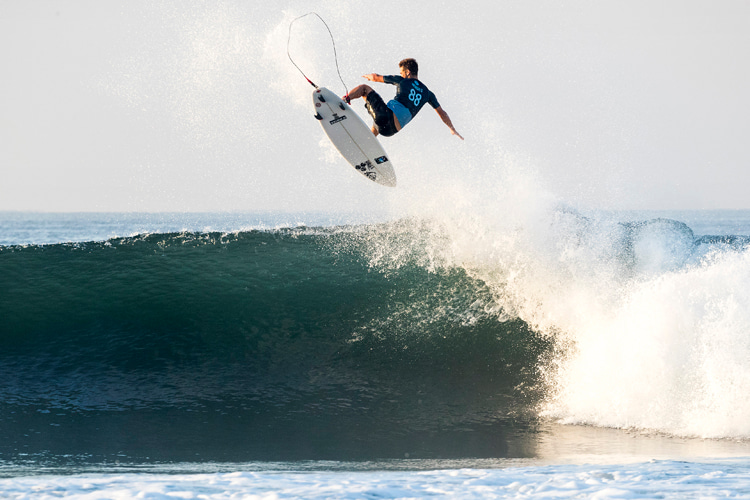

The backside air reverse is an advanced surfing maneuver that requires smart wave reading, speed, timing, and smooth body mechanics.
It demands way more than just popping off a lip, especially if you want to impress and get closer to Gabriel Medina, Kelly Slater, and Josh Kerr’s infamous airs.
The backside air reverse requires reading the wave well, carrying speed, controlling rotation, and sticking a landing while riding away.
According to experienced surfers, landing backwards and reconnecting with the wave is the hardest part, and not exactly the spin itself.
But, as with everything, you may not feel that way.
The truth is that to throw down this rather eye-catching move, you definitely need the right wave and then loads of forward momentum.
The wave should also have a steep, peaky section. In other words, something that “jumps up” when it closes out.
You’ll want to approach that section on your backside, load up speed, and then launch yourself and your board into the air.
Once airborne, you must commit: tuck, rotate, control the board under you, and then spot your landing.
If you hit the lip too late or without speed, you’ll end up doing a weak “chop hop.” Also, if you land flat or lose control in the air, the trick ends before the reverse even begins.

Easier Than the Frontside Air Reverse?
Comparing how hard (or easy) a backside air reverse is versus a frontside air reverse really depends on a few things, but there are some general differences.
Some surfers would say that launching off the lip on their backhand feels more natural when going backside.
Because you’re coming off the wave on your heelside rail and backside, the pop and lift-off sometimes feel smoother compared to a frontside setup.
On a steep, wedge-type wave section, backside rotation can carry your board smoothly off the lip if you generate enough speed. That smooth release can make the aerial rotation flow more easily.
Many surfers also find the mid-air spin on a backside air reverse feels intuitive enough.
The board will spin, your body rotates, and the sensation of airtime plus rotation may feel familiar and maybe even easier than in a frontside rotation.
…And Harder for A Few Reasons
However, a big issue with backside air reverse is the landing: you exit the lip, rotate, and must land backwards (fins-first catch), then ride away.
The transition from air to fins-catching to ride-out tends to be tougher than a simpler landing.
Moreover, when approaching backside, you often have less intuitive visibility of the wave face, meaning that timing your bottom turn, pick-up of speed, and pop demands more precise wave-reading and balance control than in frontside maneuvers.
Interestingly, research and aerial maneuver statistics reveal that frontside air reverses in competition tend to be attempted and landed more frequently than backside air reverses, probably because they’re harder or riskier.
Finally, airs involve complex landings.
Biomechanical studies note that successful aerials often depend on a stable center of mass over the board and proper foot/ankle positioning.
These details become more critical (hence more difficult) when performing airs from backside because the rotation and board orientation make landings less straightforward.
Ultimately, you might feel it works differently for you.
Backside Air Reverse 101: A Step-by-Step Guide
Ready to boost your backside air reverse to the next level? Here are a few steps you should pay attention to:
- Choose the Right Wave: Paddle into a wave with a steep, peaky section or close-out wedge. Keep looking down the line for that ramp. You need a ramp-like lip to launch off, as flat, slopy waves won’t give you lift;
- Build Speed: Pump down the wave face or do a bottom turn to generate momentum. Speed gives you the energy to pop off the lip and spin;
- Bottom Turn Into Approach: At the trough, execute a smooth bottom turn at a 20-30-degree angle, send your board upward toward the lip. The goal is to position you for a controlled approach to the lip, with speed preserved;
- Initiate Rotation and Pop: As you climb up the wave face, twist your shoulders and head toward the spin direction. Press on the tail with your back foot, front knee tucks. That builds torque and lifts the board and is critical for rotation and hang time;
- Leave the Lip and Go Airborne: As fins leave the water, stay centered, bring knees up, and balance the board under you. Why does it matter? It helps keep control in the air and prevents the surfboard from drifting away;
- Rotate and Spot Your Landing: In the air, keep your body compact, rotate torso/shoulders, and look over your toe-side rail to locate where you’ll land. Identifying a landing zone helps orient the rotation and prepare for impact.
- Land and Absorb Impact: Bend your knees, keep a balanced stance (front foot or center weight), aim tail toward whitewash or lip, allow fins to catch. Proper absorption reduces the risk of wipeout, helps continue spin smoothly;
- Ride out and finish rotation: Once you land, use wave momentum; allow fins to re-engage and complete the 360-degree rotation. It will give the maneuver its reverse finish, not just an air, but a full rotational trick;
Extra
Another interesting thing to stress is that whether backside or frontside air reverse is easier also depends on your comfort surfing backhand vs frontside, the kind of waves you get, and how good you are at reading waves and controlling balance.
If you surf regularly on your backhand and are used to backside turns, you might find backside airs more natural. If you surf mostly frontside and are comfortable seeing the wave face as you rotate, the frontside air reverse might feel more instinctive.
Words by Luís MP | Founder of SurferToday.com
Leave a Reply