
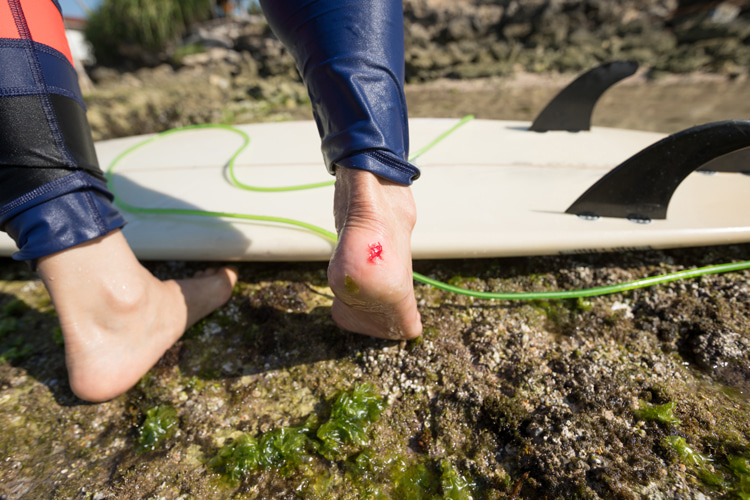

The urge to surf beats nearly everything. We take risks to get that unmatchable shot of joy of catching a few good waves in idyllic conditions.
A flu, pain in the back, a shoulder injury, a hangover, or a headache have never been a problem if we’re confronted with a “you should’ve been there” surfing moment.
The adrenaline rush of just visualizing yourself in an empty, perfectly peeling point-break-like wave overcomes most of the unpleasant feelings and pain we might be experiencing.
Two common myths surround the surfer’s mind.
The ideas that “saltwater is good for wounds” and that “surfing heals” generally blend magically in our brains.
However, the cold factual truth is rather different.
Is saltwater really good for wounds?
Sadly, the reality diverges from the myth. Saltwater from the ocean is not the same as sterile saline solution.
In fact, infectious-disease experts will tell you that swimming in the ocean isn’t a way to cure an open wound.
The thing is, unlike popular opinion, the sea isn’t a clean hospital basin. It is actually full of life, including lots of microbes.
People even tend to believe ocean water helps heal surgical cuts, but the truth is that countless bacteria and viruses lurk in seawater.
One study led by Jonathan Quinn, William Fairbairn, Gayle Silveira, and Simon Platt at Gold Coast University Hospital estimated that a single milliliter of ocean water contains around 10^5-10^7 bacteria and about 10^7 viruses.
In other words, the five oceans of the world are, on average, far from sterile.
So, the problem is these germs can immediately infect any opening in your skin, especially if your immune system is weak or your cut is already swollen and nasty.

Dangerous marine germs
What exactly are we talking about when we refer to marine germs?
Marine environments harbor a unique mix of bugs – Vibrio (flesh-eating bacteria), Aeromonas, Shewanella, Mycobacterium marinum, and more.
These scientific names might not tell you much, but they’re not exactly friendly.
Vibrio vulnificus is among the worst of the worst. It’s known to cause rapidly spreading necrotizing infections. Scary, right?
Even healthy people have gotten it from ocean cuts.
The consequence is pretty self-explanatory: if that happens, the wound can turn into a rapidly growing hole in the skin, requiring urgent surgery.
The bad news is that infections like this can be lethal.
The Centers for Disease Control and Prevention (CDC) notes 150-200 cases per year in the United States, with about 20 percent of those patients dying, sometimes within a day or two.
In severe cases, fatality rates exceed 50 percent.
When and where to worry
The water in the ocean is not homogeneous, though.
In the case of warm, brackish water, there’s an added risk and danger because Vibrio and friends love heat.
After rainstorms, runoff and sewage can spike bacterial counts, and spots like estuaries, marinas, or near reefs are known germ hotspots.
There’s even a rule of thumb in the surfing world that says that you shouldn’t paddle out after it rains.
Also, for instance, in Florida, it is not the sharks you should fear, but the microbes in the water.
But as we’ve mentioned above, your health matters, too.
If you’re on steroids, undergoing chemotherapy, or have diabetes or liver disease, your immune defenses are lower, so any cut should stay dry.
And by dry, it should be interpreted as perfectly and properly healed.
Remember that even a little infection in those cases can become dangerous much faster.

Real testimonials
In online forums, you may read several reports of unpleasant encounters with organisms we cannot see.
One longboarder described “sea ulcers” from infected cuts in warm water – wounds that didn’t heal and became deep, crater-like sores.
His advice? Don’t let your fresh cut swim free. Wrap it tight.
Many surfers swear by covering a wound with plastic wrap or a ziplock, sealing edges with strong waterproof tape, and wearing a surf bootie over the whole thing.
“Ocean water won’t let the cut heal,” warned one Californian surfer. So, he used a sandwich bag and duct tape to keep the wound bone-dry.
Others add antibiotic cream under the cover, then change bandages the minute you’re back on shore.
Tropical surf breaks can be especially tricky.
A surfer injured in Sri Lanka was advised to get medical care before getting back in the lineup, as local water had both sewage organisms and natural reef bacteria “eager for a cut,” leading to “high risk of serious and rapid infection.”
Long-term scars are common if you let a wound fester in the lineup.
If you must hit the waves with a scab, think like a doctor: use waterproof bandages and triple-antibiotic ointment, and rinse the area thoroughly with clean water right after surfing.
So, the safe answer to the question of whether it is safe to surf with an open wound is no, it is not.
Words by Luís MP | Founder of SurferToday.com
Leave a Reply