
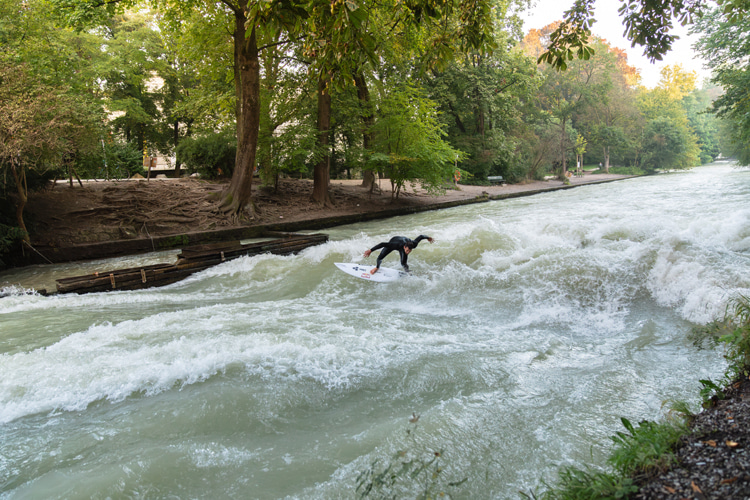

Plans to bring Munich’s legendary Eisbach river wave back to its old shape are officially falling apart.
After months of talks, studies, and paperwork, Surf Club Munich says it is ending its organized effort to restore the wave, blaming heavy bureaucracy and weak support from city officials.
“The administration does not want to regulate surfing on the Eisbach, but to prevent it,” the club said, pointing to what it called administrative obstruction after the wave vanished in October.
The Eisbach wave, a global symbol of landlocked river surfing, has been missing since city workers carried out routine cleaning of the riverbed.
Sediment, gravel, and debris were removed, and with them went the standing wave that once reached about one meter, or three feet, high.
How a City Park Became a Surf Destination
The Eisbach is a narrow tributary of the Isar River that cuts through Munich’s English Garden, one of the world’s largest urban parks.
In the 1970s, concrete reinforcements under the stream changed the water flow near a bridge, creating a powerful current.
Local surfer Walter Strasser is widely credited with turning that current into a surfing wave.
By placing a plank at a precise angle where the flow was strongest, he helped shape a wave that could be ridden nonstop.
Over time, the spot grew famous well beyond Germany.
Surfers lined up in wetsuits year-round, while tourists packed the bridge above to watch boards slash through icy water.
Safety Fears After a Fatal Accident
In April, a 33-year-old surfer died after her leash became trapped underwater.
The strong current pulled her under, and bystanders could not reach her. She was stuck for nearly 30 minutes before rescue crews were able to free her.
Paramedics revived her on the riverbank, but she died later that day in a Munich hospital. It was the first deadly accident ever recorded at the Eisbach.
Authorities carried out a safety review, and the wave reopened at the end of June. No clear cause for the accident was ever identified.
City officials say that tragedy changed everything.
October Cleanup Wipes Out the Wave
Everything changed in October 2025, when city maintenance crews cleared the riverbed. The current stayed strong, but the wave was gone.
That kicked off talks between surfers and city departments about how to rebuild it safely and legally.
Strasser told the Münchener Abendzeitung earlier in December that he had offered to help directly.
“I have so much experience with the Eisbach. I know exactly what the problem is. I could have fixed it within weeks, with very little funding,” he said.
“But the city told me they didn’t need me.”
The city asked for patience and brought in an engineering professor from the Munich University of Applied Sciences to look at possible solutions.
Christmas Surfers, a Banner, and a Fast Removal
Frustration boiled over during the holidays.
On Christmas Day, unknown surfers placed a wooden beam across the riverbed, restoring a rideable wave for several days. A banner hung from the bridge above read, “Just Watch. Merry Christmas!”
After Christmas, the city’s climate and environment department said an improvised wave device was “illegal and potentially dangerous,” adding that “the city must not and cannot tolerate impermissible structures at the Eisbach wave.”
Early Sunday morning, the fire department moved in and removed the structure. Surfing was once again banned.
The fire department and city officials made clear that any unauthorized construction in the river would be taken out immediately.
Red Tape Pushes Surfers Away
Soon after, Surf Club Munich announced it was stepping back from its official efforts. The group said the process had become political and unworkable.
Another local group, IGSM, described a similar experience. The association said the city kept adding “ever more conditions and added demands.”
These included indemnifying the city for any risks during a test phase and providing an engineering certificate proving the nearby bridge could handle attachments for a wave device.
IGSM also stressed that the Eisbach is not for beginners.
“It is not a wave for beginners and not a place to start with river surfing, even if one already has experience in the ocean,” the group warned.
Concrete blocks behind the wave act as brakes for the current, and a bad fall can push a surfer against them with what the group described as several tons of water pressure.
Their rules call for experienced, fit surfers only, along with the use of a breakaway leash.
For now, the Eisbach continues to flow through the English Garden without its iconic static wave. Is good news looming on the horizon for 2026?
Leave a Reply