
The University of Amsterdam (UvA) and Surf Pill are launching a joint research project to investigate whether a floating surf installation with integrated water purification can improve water quality in Amsterdam’s inner waterways.
Once the permitting process has been completed, the first prototype will be built in Amsterdam-Noord.
During the Paris 2024 Olympic Games, it became visible how vulnerable urban waters can be.
Major investments were needed to make the Seine suitable for swimming, but after heavy rainfall, bacterial levels again rose to unsafe levels.
The attention gave a boost to the Swimmable Cities movement, which by mid-2025 brought together over 150 organizations from more than 80 cities in 30 countries, all working to restore urban waterways.
In early November, London also joined, alongside cities such as Paris, Budapest, and Rotterdam.
Amsterdam faces similar challenges. In particular, shallow, stagnant areas behind bridges and near quaysides can show rapid increases in bacterial levels.
The municipal health service (GGD) regularly issues warnings about elevated E. coli concentrations.
Large infrastructure projects to improve water quality, such as sewer renewal, have long lead times.
The research, therefore, focuses on whether small-scale interventions at local problem spots can provide relief more quickly.
Stagnant Water as a Key Factor
“In urban waters, several factors come together, but areas with little flow stand out because the values there tend to rise faster,” says Dr. Petra Visser, Associate Professor of Algal Ecophysiology at the UvA.
“Together with Surf Pill, we are investigating whether interventions such as filtration, aeration, and circulation can break that pattern locally.”
“For us as a university, this is valuable because cities worldwide are looking for ways to improve water quality.”
With this project, we want to show how science can contribute to a livable, healthy urban environment where people can safely enjoy the water.”
The research, supervised by Dr. Petra Visser and Dr. Arie Vonk, focuses on measurable effects in the water directly around the installation.
Researchers will look at bacterial levels, clarity, dissolved oxygen, blue-green algae, metal concentrations, and biodiversity.
Measurements will be compared with reference points elsewhere in the canal and with the situation before the installation is in place.
How a Wave Can Help Clean Water
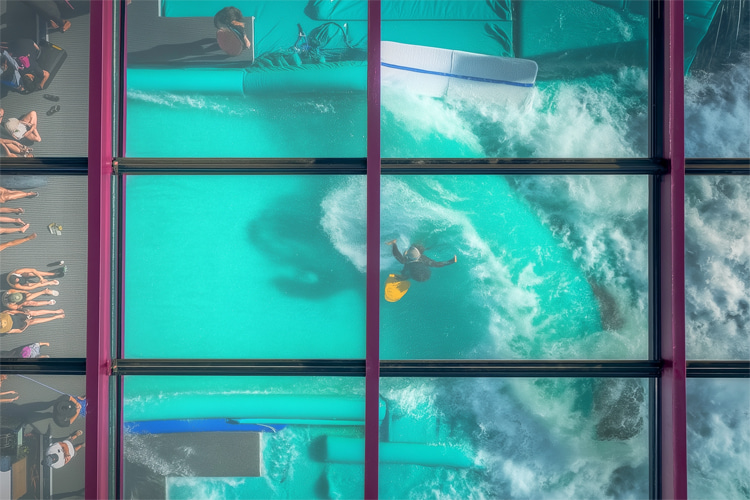
Surf Pill is a floating surf platform with integrated water purification, specifically developed for urban waters.
The concept was submitted by founder Frederik van Os to a participation program in Amsterdam and received strong public support, with a proposed location in Amsterdam-Noord.
The concept combines three principles for improving water quality. Filtration removes suspended particles, aeration increases oxygen levels, and circulation disrupts stagnant water.
This approach is widely used in swimming pools and drinking water treatment, but it is rarely applied directly in public urban waters.
A similar example has been claimed by the Unit Surf Pool technology, though.
“Once we obtain the permits for Surf Pill, we will build a platform measuring fifteen by 30 meters,” says Surf Pill founder Frederik van Os.
“The continuous surf wave will keep the local canal water moving and push it through filters, after which it flows back into the surface water in a cleaner state.”
“We will also place aquatic plants around the platform as an additional form of purification, as these plants absorb nutrients from the water.”
“The aim is for the surrounding water to become safer and clearer, so that residents can swim in their own canals again and children can play safely by the water.”
First Answers Within a Year
The collaboration will run for at least twelve months and will be carried out by students and researchers from the UvA’s Institute for Biodiversity and Ecosystem Dynamics (IBED).
The researchers will measure water quality at different distances from the installation to determine how far the effects extend.
In addition to water quality, the project will also look at ecological effects such as biodiversity and plant growth.
The first measurement results are expected after one full season of operation, which will also provide insight into seasonal effects and the influence of weather.
Master’s students will be able to participate in the monitoring program.
Leave a Reply