
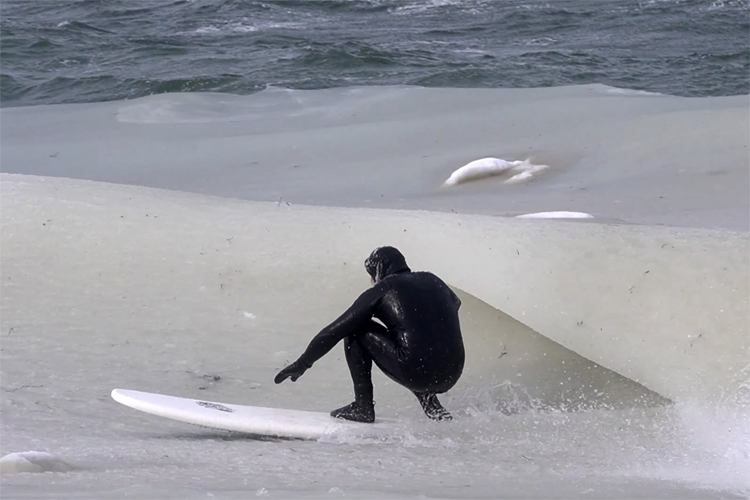

Before sunrise, with the thermometer reading 18 °F (-8 °C) and the wind chill dipping to -4°F (-20 °C), surfer and YouTube creator Ben Gravy set out on what he calls a decade-long dream: to surf a wave that wasn’t quite water and wasn’t quite ice.
It was 4:22 a.m. when Gravy and his crew hit the road from New Jersey, chasing reports of a rare phenomenon along the eastern edge of Long Island: “slurpee waves,” also known as frozen or slushy waves.
The term describes ocean waves so cold and ice-choked that their surface resembles crushed ice, like a granita or a half-frozen convenience-store drink.
“Slush Nation reporting for duty,” Gravy said as the group began the drive north, bundled in winter gear and fueled by adrenaline.
Outside, it was one of the coldest mornings of the winter so far. Offshore winds were howling. Swell was pushing toward 10 feet. And inside the breaks, ice had begun to form.
By the time they reached Montauk, locals and photographers had already begun to document the scene: rolling Atlantic waves capped with slush, their energy slowed and distorted by floating ice.
It looked surreal – powerful, yet muffled, as if the ocean itself were moving in slow motion.
“It’s kind of nuts,” one surfer said while scanning the horizon. “The ice isn’t moving. That’s crazy.”
An in-between state wave
Slurpee waves are rare, even in cold-water surf zones. They require a precise mix of subfreezing air temperatures, strong wind, active swell, and near-freezing seawater.
The result is a strange hybrid – waves that still break, but through a semi-frozen surface that changes their texture, speed, and danger.
And danger there was.
When Gravy and Travis Beckmann first entered the water, the slush immediately altered everything they thought they knew about buoyancy and movement.
Paddling became sluggish. Boards lost responsiveness. Progress forward slowed to a crawl.
“I’ve never experienced anything like that in my life,” Gravy said afterward.
Now I understand why people drown in ice. You can’t move. You’re not going forward or backward – you’re just going under.”
His friend described it more vividly.
“It was as if someone grabbed us with one of those little cranes and dropped us straight into a Slush Puppie machine,” he said.
“You think, ‘Just spin around, and you’ll get out.’ That doesn’t happen.”
In normal surf, water flows around a board and body. In slush, that flow is blocked.
Every paddle stroke meets resistance, and waves break with a strange, delayed force. The surfers found themselves sliding rather than carving, more like snowboarding than surfing.
“You weirdly have control because you’re going half a mile an hour,” Gravy explained. “It’s like holding a rail in the snow.”
Still, the waves were real and heavy. One of Gravy’s rides, he said, ranks among the most memorable of his career.
“That was top three,” he said. “After a long career, top three.”

Ephemeral as a swell
The session didn’t come without close calls.
At one point, the group struggled just to exit the slushy inside section, fighting wind and ice as they were pushed backward toward breaking waves.
Later, warming up inside a vehicle brought its own scare when a heater filled the car with smoke, forcing them back into the cold air.
Yet the mood remained buoyant.
Between sessions, the surfers joked with locals, thanked Montauk residents for the access, and warmed their throats with hot drinks that “burned a little on the way down.”
As the sun rose, the slurpee waves began to change. Tides shifted. Conditions softened. Eventually, the crew made the call to wrap it up, satisfied and relieved.
“Thanks for coming to Montauk,” one local told them as they packed up. “That was sick.”
The always-on-for-experimental-stuff, Ben Gravy, it was an unforgettable session.
“I’ve been wanting to do this for a decade,” he said. “Slushy waves at the end of the world.”
Leave a Reply