
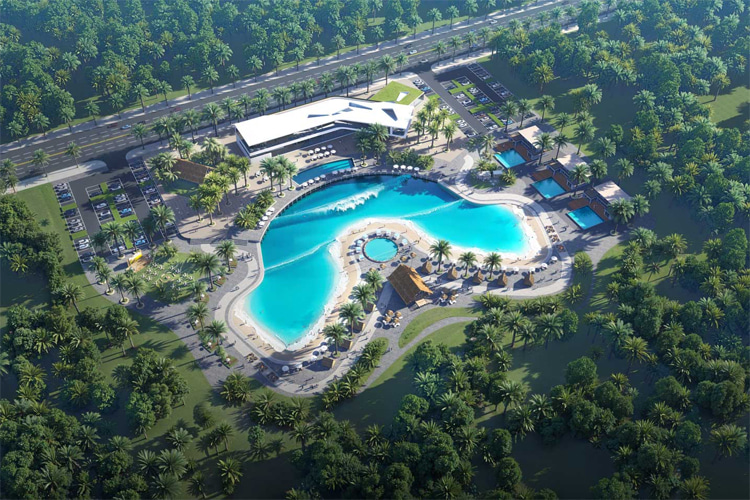

SurfLoch has been building artificial waves for more than four decades, but its newest design, the WaveBender, is easily the company’s boldest turn yet.
WaveBender is way more than just a refreshed footprint or a bigger pool. It’s an attempt to make a mechanical reef behave like a real one, complete with a wave face that actually curves toward the surfer.
“It is the culmination of 40 years of innovation. The easy road was a straight line, but that’s not the best wave in nature,” said founder Tom Lochtefeld.”
But before we learn more about WaveBender, we need to understand the brain behind it.
Who is Tom Lochtefeld
Tom Lochtefeld is the founder and CEO behind a family of companies: Wave Loch, Surf Loch, and Wave House.
Born in Coronado, California – on the naval base at North Island – Tom grew up surfing around San Diego, spending many hours chasing waves at spots like Big Rock in La Jolla.
He started his professional life in real estate law, but surfing remained a passion that made him dream of bringing reliable waves to inland venues.
Tom’s journey toward artificial waves began in the late 1980s.
While living near waterparks he helped develop in California, he got the idea that you could replicate a wave by shooting water over a curved slope, a concept that would soon become the sheet wave.
He worked with hydraulics experts at the research lab at Scripps Institution of Oceanography to model and refine the concept.
Those early experiments led to a patent filed in 1988 for a “wave-forming generator for generating inclined surfaces on a contained body of water.”
In 1991, the first full-scale version of this idea hit the water: the debut of the first FlowRider wave at a waterpark in Texas.
That simple sheet-wave machine fundamentally changed what a surf attraction could be.
A few years later, in 1993, Tom and his team launched the larger, curling version known as FlowBarrel, this time at a resort in Norway.
That expanded the possibilities: more speed, more challenge, more of that wave-feel for riders.
Through the 1990s and early 2000s, FlowRider and FlowBarrel installations spread around the world in waterparks, resorts, and even cruise ships.
Eventually, the sheet-wave concept and its spin-offs supported over 200 installations in dozens of countries.
But Tom didn’t stop at just building waves. He envisioned surf attractions that mixed sport, entertainment, and lifestyle.
That vision became the blueprint for Wave House venues, which are surf machines surrounded by shops, bars, music, skateparks, and more.
The first Wave House opened in 2001 in Durban, South Africa.
Then came others, including a high-profile one in San Diego, right near Wave Loch’s headquarters.
The format proved powerful: it appealed not just to surfers, but to anyone looking for a fun, social water-centric experience.
In doing this, Tom helped popularize an entirely new sport – flowboarding – and brought surfing-style thrills to people far from the ocean.
Even with the worldwide success of FlowRider and FlowBarrel, Tom still felt something was missing.
The sheet-wave machines delivered for quick fun and high volume, but they lacked the depth and realism of a true surf wave.
So after decades in the stationary-wave game, he sold off FlowRider in 2014 to dive fully into a new mission: build a deep-water surf pool that delivers authentic ocean-style waves.
Later, he founded SurfLoch – a company dedicated to turning that dream into reality and creating powerful, surfable waves that can run all day, serve surfers of every level, and bring genuine surf experiences inland.
With over 100 patents to his name, Tom has led what many consider the most successful wave-making operation in the world.
What WaveBender Is
WaveBender is a new surf-pool design built around SurfLoch’s well-known pneumatic caisson engines, the same tech powering the waves at The Palm Springs Surf Club and the RiF010 urban surf project in Rotterdam.
But the overall layout is completely re-imagined.
Instead of placing the caissons along a straight wall, SurfLoch set them in a semicircle.
That curved line of wave engines works together with a redesigned pool floor with a shape that allows the wave to pivot as it breaks, bending toward the surfer like a proper reef pass.
A press statement describes it as delivering “ocean-like power and a uniquely sculptured wave face that bends toward the surfer,” thanks to patented wave-bending mechanics that “dynamically warp the wave toward the surfer, mirroring the physics of natural reef pass breaks.”
How It Works
WaveBender still fires waves using compressed-air caissons, but their new semi-circular placement changes how the pulse of water enters the pool.
The poolbed contour then guides the wave as it breaks, controlling how far it peels, how steep it gets, and how much it wraps back toward the rider.
The system runs in both a 1-degree and 3-degree bending mode, allowing operators to tune how aggressively the wave wraps.
Wave height holds up to six feet while staying under a 2-megawatt power ceiling.
SurfLoch designed the pool to produce single-direction waves, A-frames, and multiple beginner zones.
The 3-degree version launches 15-second rides every 15 seconds.
The newer layout shown in industry previews pushes the rhythm even faster: a wave every 13 seconds with ride times stretching past 18 seconds.
That throughput – plus simultaneous lefts, rights, and learner areas – gives the pool roughly double the capacity of many competing surf parks.
Lochtefeld said the inspiration came straight from reef passes: “The vision was creating a tropical reef pass, a wave that is constantly bending in at you.”
“Curves are constantly changing, and the nonlinear math for solving the Navier-Stokes equations is not trivial. But Surf Loch succeeded, and Wavebender was born.”
What Makes It Different
Artificial-wave systems generally fall into two camps.
Some, like Endless Surf, Wavegarden, and PerfectSwell, shape a traveling swell with caissons or mechanical paddles as it moves down the pool.
Others, like Surf Lakes or SwellMFG, push out a central pulse that breaks as it moves across a custom floor.
WaveBender flips SurfLoch’s own “deep end” logic by changing where – and how – the power is created.
The semi-circular engine line acts like a reef shelf that wraps incoming swell.
Instead of a straight mechanical wedge producing a predictable shoulder, riders get a wave that behaves more like a natural point or reef break, complete with hollow sections and air ramps.
The technology also aims to serve everyone from beginners to pros, not by dialing the same wave up or down, but by carving distinct zones into the pool so learners, cruisers, and aerialists all have their own lines.
Behind the Scenes
Operators run WaveBender through SurfLoch’s WaveWare software, which manages wave settings, session types, and equipment performance.
It’s the same system already running in Palm Springs and Rotterdam, so future parks will inherit a proven control setup rather than a prototype dashboard.
Facilities can customize the overall layout – beach angles, spectator zones, and circulation paths – depending on real-estate needs or revenue goals.
As Lochtefeld puts it, “It’s about creating destinations where surfers find the waves they love, where developers find an investment with high ROI, and where the sport continues to grow.”
WaveBender pools are already in development in the United States, Brazil, and Australia. Public renderings are slated for 2026, with more technical details expected to follow.
For now, the early numbers – six-foot faces, 15-second barrels every 15 seconds, 18-second rides every 13 seconds, A-frames on tap, and a bending wave that mimics a reef pass – suggest a surf pool that wants to feel less like a machine and more like a trip to the tropics.
Words by Luís MP | Founder of SurferToday.com
Leave a Reply